

Recent Promotions
No promotions recorded for this influencer yet.
Latest X Posts

Fable 5 leaves your plan tonight steal its brain before it's gone.. then a cheaper model keeps its output for you capture 4 things while you still have it: 1. standards → make Fable write your CLAUDE.md + skills as checkable quality bars, so Opus hits Fable's bar 2. strategy → a roadmap Fable already reasoned through, so Opus just executes it 3. knowledge → deep research atomized into linked notes, the context every session reads 4. reasoning → a recorder skill that saves how Fable cracked each hard problem, for next time wire the recorder to fire on its own.. drop this in CLAUDE.md: ## learning law after every solved problem, run the extract-approach skill a solution without its learnings note is unfinished work then route against a rubric, not a vibe: - Opus runs the task, reading Fable's playbook first - a judge grades the output against the quality bar from step 1 - only what fails the bar escalates to a frontier call most work never escalates.. capturing costs nothing today, routing runs for a fraction you're not upgrading Opus.. you're removing the problems that needed a genius the full playbook is in the article below ↓ read it before midnight
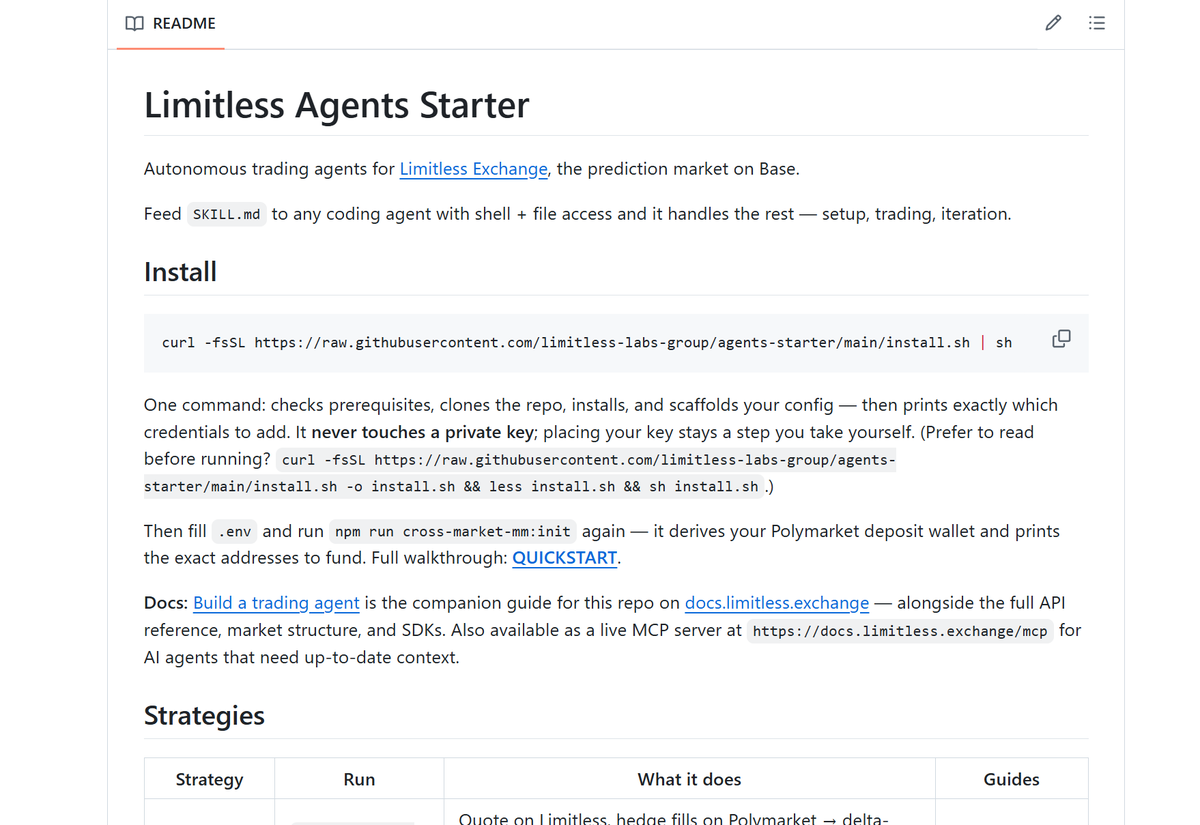
IMPORTANT RESOURCES: Repo: http://github.com/limitless-labs-group/agents-starter Join the builders community: http://t.me/LimitlessBuildersChat https://t.co/NwFQG0xTu2
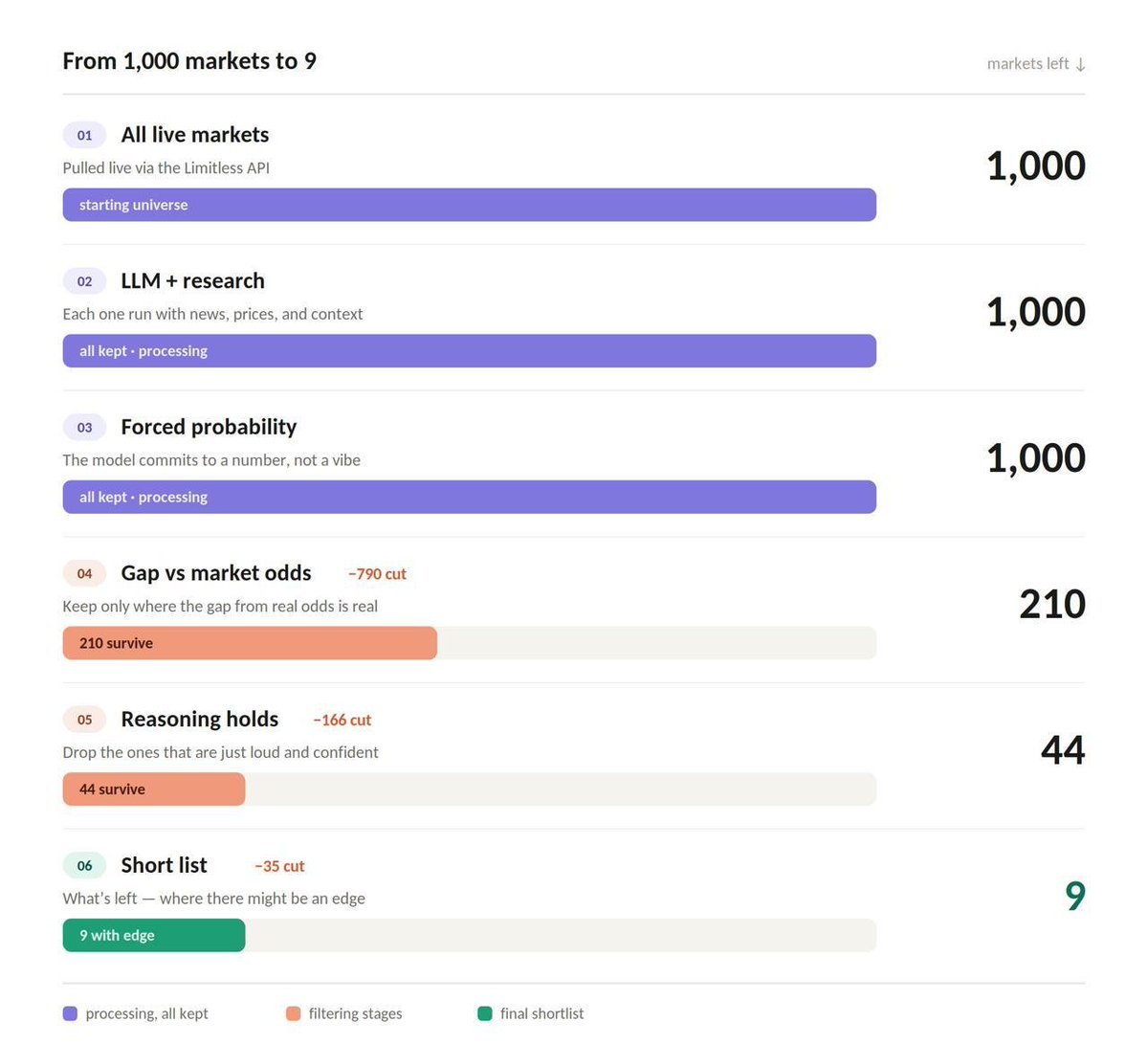
everyone thinks you can point an LLM at prediction markets and "print money" i tested it on Limitless that's not what happens recent benchmark: 7 frontier models on live markets only 2 made money the rest lost while reporting high confidence so the edge isn't "let AI trade" the edge is knowing WHERE the model is actually sharp here's the forecaster i built on the Limitless API: [ how it works ] - pulls live markets via the Limitless API - runs each through an LLM with a research step (news, prices, context) - forces a probability, not a vibe - compares the model's number vs the real market odds - only flags markets where the gap is real AND the reasoning holds the useful part: it filters out the markets where the model is just loud and confident which is most of them what's left is a short list where the model might actually have an edge every piece is replicable repo + full breakdown drops in the next post still early financial risk is real this is research, not advice
nobody gets a $350k offer from Anthropic with a certificate they get it by showing what they've shipped 5 pet projects that make you unrejectable: 1. a production RAG system chat-with-your-docs with reranking + citations, deployed.. the single most in-demand skill right now 2. an agent from scratch, zero framework proves you understand the loop.. not just how to glue LangChain together 3. an eval harness anyone can demo.. proving it works across 100 inputs is what separates seniors from juniors 4. a fully deployed product docker, auth, cost caps, logging.. survives real traffic at 2am 5. a real business automation lead qualification or support triage that saves someone actual money they don't care what you studied.. they care what you shipped the full roadmap to build all 5 is in the article.. save it

i guess this is the only article you need to understand the narratives of the next decade [ my takes: ] > if even the military and police automate, your work will too.. be the one building the automation, not the one replaced by it > AI will find edges in every field no human can see.. pick a niche and let it find yours before someone else does > the current world order isn't guaranteed.. build things that stay useful even when the ground shifts > a line is forming between people who own AI systems and people who just use them.. get on the ownership side now > the biggest AI leap is still ahead of us.. build for the model you'll have in a year, not today's 46 predictions in total.. read every one
Frequently Asked Questions
Ronin is an AI crypto influencer active on Twitter, specializing in artificial intelligence and Web3. Ronin provides expert analysis and insights on emerging AI projects within the decentralized ecosystem, guiding followers through innovations in blockchain technology. More details can be found on their Crypto Dapp profile.
Ronin primarily covers topics at the intersection of artificial intelligence and Web3. They focus on sharing expert analysis and insights on emerging AI projects within the decentralized ecosystem and innovations in blockchain technology.
You can follow Ronin on Twitter, where they share expert analysis and insights. Ronin's content focuses on AI projects within the decentralized ecosystem and advancements in Web3.
Ronin creates analysis, insights, and threads focused on AI and Web3. They share expert commentary on emerging AI projects and innovations in blockchain technology, primarily through their Twitter presence.
Ronin is worth following for crypto insights due to their specialized expertise in AI and Web3. They provide valuable analysis and insights on emerging AI projects within the decentralized ecosystem, and their profile is verified on Crypto Dapp.
You can collaborate with Ronin on content types such as analysis, insights, and threads. Specific details regarding collaboration and requirements may be available directly on their Crypto Dapp profile.
Ronin stands out through their specialized focus on the intersection of artificial intelligence and Web3. Their content provides expert analysis on emerging AI projects within the decentralized ecosystem, setting them apart in the English-speaking crypto space.
Other Influencers

vitalik.eth
vitalik.eth offers profound insights primarily focused on blockchain technology and the evolution of Ethereum. His contributions are prominently featured on Twitter, where he regularly shares his perspectives, and he actively participates in shaping discussions across the broader Web3 ecosystem. He is known for his deep dives into the complex landscape of decentralized systems. Content themes frequently explored by vitalik.eth include the philosophical underpinnings of digital currencies, the ongoing development of the Ethereum protocol, and the future trajectory of web decentralization. He often discusses topics such as scaling solutions, protocol design, and the broader implications of decentralized technologies for society and global coordination. This content is presented in English. Readers and viewers who benefit most from following vitalik.eth are those interested in the foundational technical aspects of blockchain, the philosophical dimensions of decentralization, and the long-term vision and challenges facing the Web3 space. His discussions provide valuable context for understanding the core ideas driving the ecosystem.

Watcher.Guru
Watcher.Guru provides high-frequency, real-time coverage of global cryptocurrency and finance markets. As a prominent voice in the news and media niche, Watcher.Guru is primarily active on Twitter, where they deliver constant updates to their followers. Their approach centers on immediate dissemination of information across the digital asset landscape. Content themes frequently explored by Watcher.Guru include breaking news in blockchain regulation, significant market movements, and the ongoing developments in institutional adoption of digital currencies. They consistently offer real-time updates and market analysis, providing snapshots of key events as they unfold. This focus helps followers stay informed on critical shifts within the industry. Watcher.Guru's content caters primarily to an English-speaking audience, with a significant following in countries like the United States, United Kingdom, Canada, and Australia. Viewers and readers who benefit most from following Watcher.Guru are those who require rapid, unbiased information on current events and market changes in the crypto and traditional finance sectors. They are an ideal follow for anyone needing immediate insights into the fast-paced world of digital assets.

Altcoin Daily
Altcoin Daily provides engaging market analysis and breaking news for the crypto space. The channel focuses on essential updates across Bitcoin, Ethereum, and Solana, delivering content primarily through YouTube, Twitter, and Instagram. With a consistent presence on these platforms, Altcoin Daily keeps its audience informed about the rapidly evolving digital asset landscape. Content themes frequently include discussions around macroeconomic impacts on cryptocurrency markets, such as Federal Reserve actions and global economic shifts. They often explore significant institutional crypto adoption announcements and their implications for major assets. Viewers can expect to see analysis on Bitcoin and Ethereum price movements, alongside urgent market news and insights into potential regulatory developments that could affect holders. The audience for Altcoin Daily primarily spans English-speaking regions including the United States, United Kingdom, Canada, and Australia. Viewers who benefit most from following Altcoin Daily are those seeking comprehensive market overviews, explanations of key news events, and perspectives on how broader economic and institutional trends influence the crypto market. It is well-suited for individuals looking to stay informed on major industry narratives.

CoinDesk
CoinDesk operates as a prominent global media company, specializing in delivering comprehensive news, insights, and data across the cryptocurrency and blockchain technology sectors. Their primary niche centers around providing timely crypto news and in-depth analysis. While actively engaging with audiences on platforms like Twitter, CoinDesk also offers extensive coverage through their website, podcasts, and specialized market reports. CoinDesk's content consistently explores themes such as evolving market trends, significant regulatory developments, and future innovations within the blockchain sector. They frequently provide detailed market analysis and data insights, often drawing from their coverage of major industry events. Recurring topics include the impact of macro events on crypto, specific protocol updates, and emerging use cases for distributed ledger technology. With a global footprint that includes audiences in the US, Spain, and Hong Kong, CoinDesk caters to an international readership, publishing content in both English and Spanish. Individuals seeking detailed, current information on the broader crypto and blockchain ecosystem, including market movements, technological advancements, and regulatory landscapes, will find immense value in following CoinDesk's consistent updates. This content is particularly useful for industry professionals, investors, and enthusiasts who require reliable context.
Sign in to watch & analyze
Videos, engagement metrics and FAQs are free for registered users.